
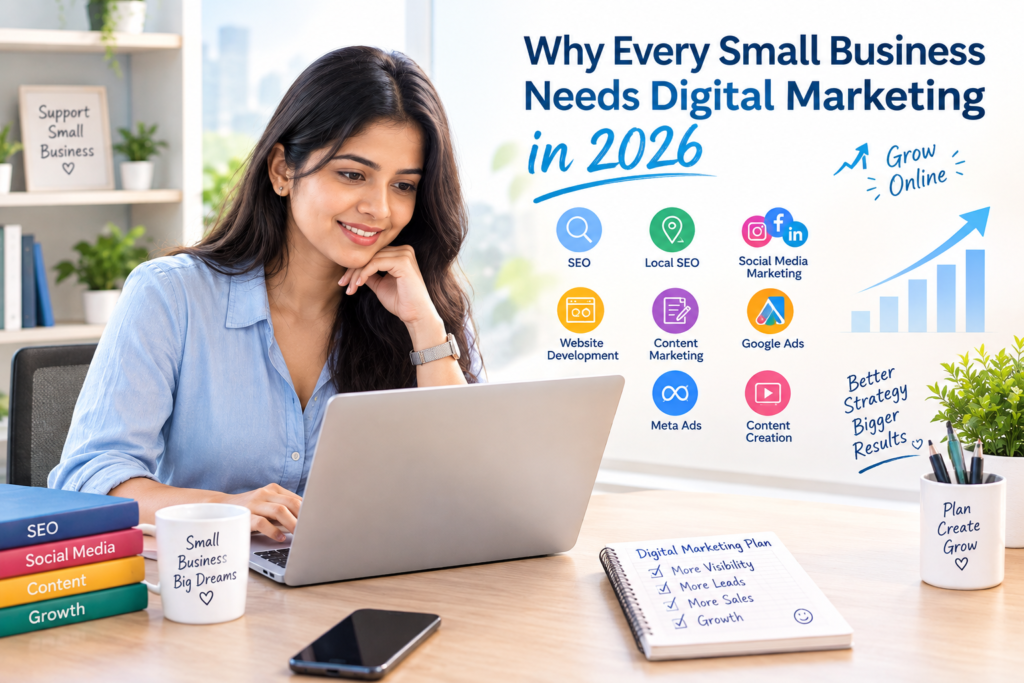
For small businesses, getting noticed has always been one of the biggest challenges. In the past, businesses could depend heavily on word-of-mouth recommendations, newspaper advertisements, banners, flyers, and local networking. While these methods can still have value, the way customers discover and evaluate businesses has changed significantly.
Today, a potential customer may search on Google, check Instagram, read online reviews, visit a website, compare competitors, and even use an AI-powered search tool before deciding where to spend their money.
This is why digital marketing for small businesses is no longer simply an optional way to promote a brand. It has become an important part of building visibility, credibility, customer relationships, and long-term growth.
In 2026, a strong digital presence can help a small business compete not only with nearby competitors but also with larger brands that have bigger marketing budgets.
Whether you run a local shop, professional service, startup, restaurant, consultancy, beauty business, coaching service, or home-based business, digital marketing can help your business reach the right people at the right time.
What Is Digital Marketing?
Digital marketing refers to promoting a business, product, or service through digital channels such as search engines, websites, social media platforms, online advertising, email, content, and other digital platforms.
Unlike traditional marketing, digital marketing allows businesses to reach specific audiences and measure how people interact with their campaigns.
Some important areas of digital marketing include:
- Search Engine Optimization (SEO)
- Local SEO
- Social Media Marketing
- Content Marketing
- Website Development
- Google Ads
- Meta Ads
- Content Creation
- Online Reputation Management
- Analytics and Performance Tracking
- Answer Engine Optimization (AEO)
- AI and search optimization
A business does not necessarily need to use every channel at once. The right strategy depends on the business, its customers, goals, location, budget, and industry.
Why Digital Marketing Matters More in 2026
Customer behaviour continues to move toward digital platforms. Before contacting a business, people often want to know who the business is, what it offers, where it is located, what other customers think about it, and whether it appears trustworthy.
This creates an important opportunity for small businesses.
If your business appears when potential customers are searching for your products or services, you have a chance to become part of their decision-making process.
If your competitors appear everywhere online while your business has little or no digital presence, customers may never discover you.
Digital marketing helps close this visibility gap.
1. Customers Are Searching Online
One of the biggest reasons small businesses need digital marketing is simple: customers are online.
Someone looking for a service may search Google for terms such as:
- Digital marketing services near me
- Best salon in Mumbai
- Web designer in Jogeshwari
- SEO services in Mumbai
- Local restaurant near me
- Accountant near me
The businesses that appear during these searches have an opportunity to attract those customers.
This is where SEO and Local SEO become valuable.
A strong online presence helps your business become discoverable when people are actively looking for what you offer.
2. Digital Marketing Helps Build Brand Awareness
People usually do not become customers the first time they see a business.
They may come across your Instagram page today, see your website next week, notice your Google listing later, and finally contact you when they are ready to buy.
This repeated exposure helps create brand awareness.
For a small business, consistent digital marketing can help people recognize your name, understand your services, and remember your brand.
Your website, social media profiles, content, advertisements, and visual identity should work together to communicate a consistent message.
Over time, this can make your business more familiar and easier to remember.
3. A Professional Website Builds Credibility
Your website is often one of the first places a potential customer visits after discovering your business.
A professional website can provide essential information such as:
- What your business does
- Products or services offered
- About the business
- Contact information
- Location
- Customer reviews or testimonials
- Portfolio or previous work
- Frequently asked questions
- Ways to get in touch
A website can also help establish credibility.
Imagine two businesses offering similar services. One has a professional, easy-to-use website containing clear information, while the other has almost no online information.
A customer may naturally feel more comfortable researching the business that provides a clear digital experience.
For small businesses, website development should therefore be viewed as more than simply creating an online page. It is about creating a useful digital destination for potential customers.
4. SEO Can Help You Get Found on Google
Search Engine Optimization, commonly known as SEO, helps improve the visibility of a website in search engine results.
For small businesses, SEO can be especially valuable because it can attract people who are already searching for relevant products or services.
For example, a business providing web development services in Mumbai could create useful content around topics such as website development, business websites, website costs, and local web development services.
Over time, well-optimized and useful content can help the website become more relevant for appropriate searches.
SEO is not about adding keywords everywhere. Modern SEO is about providing useful information, creating a good website experience, understanding search intent, and making content easy for both users and search engines to understand.
5. Local SEO Helps Small Businesses Reach Nearby Customers
For businesses serving a specific location, Local SEO can be particularly important.
A customer searching for a service may prefer a business that is nearby and easy to contact.
Local SEO focuses on improving visibility for location-based searches.
For example:
“digital marketer in Jogeshwari”
is more specific than simply searching for:
“digital marketer.”
A business targeting a particular locality can use location-focused content, a properly maintained Google Business Profile, consistent business information, reviews, relevant website content, and other local SEO practices to improve its local visibility.
For small businesses in Mumbai, appearing in relevant local searches can help connect the business with customers who are more likely to become actual enquiries.
6. Social Media Helps Businesses Connect With Customers
Social media has become an important communication channel for businesses.
Platforms such as Instagram and Facebook allow businesses to showcase their products, services, work, ideas, customer experiences, and personality.
But social media marketing is not simply about posting every day.
A successful social media strategy should have a purpose.
Different types of content can serve different goals:
- Educational content can build authority.
- Behind-the-scenes content can make a brand feel more human.
- Testimonials can build trust.
- Reels can increase reach.
- Service-related content can generate enquiries.
- Helpful tips can encourage engagement.
- Brand stories can create emotional connections.
The goal should not always be to get viral content. For a small business, reaching the right audience and building meaningful relationships can be more valuable than collecting random views.
7. Content Marketing Builds Trust
Customers have questions before they buy.
They may want to know:
- Which service is right for me?
- How much does it cost?
- Why do I need this service?
- How does the process work?
- What mistakes should I avoid?
- How can I compare different options?
Content marketing allows businesses to answer these questions.
A business can publish blogs, guides, FAQs, videos, social media posts, case studies, and other useful resources.
For example, a digital marketing professional could publish articles explaining SEO, Local SEO, Google Ads, social media marketing, and website development.
When businesses consistently provide useful information, they have more opportunities to demonstrate their knowledge and build trust before a customer makes an enquiry.
8. Digital Advertising Can Generate Faster Visibility
Organic marketing strategies such as SEO and content marketing can take time.
Paid advertising can provide another way to reach potential customers.
Platforms such as Google Ads and Meta Ads allow businesses to create targeted campaigns based on factors such as search intent, location, interests, demographics, and other available audience signals.
For example, a local service provider may want to advertise specifically to people in selected areas.
However, running advertisements does not automatically guarantee results.
Successful advertising requires:
- Clear objectives
- Relevant targeting
- Strong ad copy
- Good creatives
- Appropriate landing pages
- A realistic budget
- Conversion tracking
- Continuous testing and optimization
The goal should be to generate meaningful business results rather than simply spend money for clicks or impressions.
9. Digital Marketing Is Measurable
One major advantage of digital marketing is the ability to measure performance.
Traditional advertising can sometimes make it difficult to determine exactly how many people saw an advertisement and how many became customers.
Digital platforms can provide useful performance data.
Businesses can track metrics such as:
- Website visitors
- Search impressions
- Clicks
- Engagement
- Leads
- Conversion rates
- Advertising performance
- Social media reach
- Cost per lead
This information can help a business understand what is working and where improvements are needed.
Instead of relying entirely on assumptions, businesses can use data to make better marketing decisions.
10. Digital Marketing Helps Small Businesses Compete With Larger Brands
Large companies often have bigger advertising budgets, larger teams, and greater brand recognition.
However, digital marketing has created opportunities for smaller businesses to compete for attention.
A small business can create useful content, target a specific local audience, build a strong reputation, optimize its website, engage with customers, and develop a recognizable brand without needing the resources of a large corporation.
For example, a local professional may not need to compete nationally.
They can focus on becoming visible for relevant services in their own area.
This is one reason local digital marketing can be powerful for small businesses.
11. Reviews and Online Reputation Matter
Before choosing a business, customers often look for social proof.
Reviews can influence how people perceive a business.
Positive and genuine customer feedback can provide reassurance to potential customers who are considering contacting you.
Businesses should therefore pay attention to their online reputation.
This includes:
- Encouraging genuine customer feedback
- Responding professionally to reviews
- Addressing genuine complaints
- Maintaining accurate business information
- Providing a consistent customer experience
Digital marketing does not end when a customer makes a purchase. Customer experience and reputation can influence future growth as well.
12. AI Is Changing How People Search
Search is becoming more conversational.
People are increasingly using AI-powered tools to ask questions, compare options, understand topics, and discover businesses.
This means businesses should think beyond traditional keyword rankings.
Content should be clear, useful, trustworthy, and structured around real customer questions.
This is where concepts such as AEO (Answer Engine Optimization) and optimization for AI-driven discovery are becoming increasingly relevant.
Businesses should focus on creating content that directly answers customer questions rather than producing content only for search engines.
For example, instead of writing a generic article about digital marketing, a business can answer practical questions such as:
“How much does digital marketing cost for a small business?”
or
“How can a local business get more customers from Google?”
Useful, direct answers can make content more valuable across different search experiences.
13. Digital Marketing Helps Generate Better Leads
Getting traffic is not the final goal.
A business ultimately needs customers.
Digital marketing can help move people through different stages of the customer journey.
A potential customer may first discover your business through a Google search or social media post.
They may then visit your website.
After reading your content or checking your services, they may contact you.
This means your digital presence should make the next step easy.
Clear calls-to-action such as:
Book a Consultation
Get a Quote
Contact Us
Send an Enquiry
or
Learn More
can help guide visitors toward taking action.
14. Consistency Is More Important Than Being Everywhere
One common mistake small businesses make is trying to use every digital platform at the same time.
You do not necessarily need to be everywhere.
Instead, identify where your potential customers spend time and where they are likely to search for your services.
For one business, Google Search and Local SEO may be the priority.
For another, Instagram and content marketing may be more important.
For a B2B company, LinkedIn and search marketing may be more relevant.
The best digital marketing strategy is not the one with the largest number of platforms. It is the one that connects your business with the right audience.
How Can a Digital Marketer Help a Small Business?
Managing digital marketing can become difficult when business owners are already handling customers, operations, finances, employees, and daily responsibilities.
A digital marketer in Jogeshwari can help a local business understand its online goals and develop a practical strategy around them.
This may include:
- SEO strategy
- Local SEO
- Website planning
- Social media marketing
- Content creation
- Content marketing
- Google Ads
- Meta Ads
- Lead generation
- Online visibility
- Performance analysis
The role is not simply to post content or run advertisements.
A good digital marketing approach should connect different activities to a larger business objective.
Why Small Businesses Should Start Now
One of the biggest mistakes a business can make is waiting until competitors have already established a strong online presence.
Digital growth takes time.
SEO takes time to build.
A social media audience takes time to develop.
A website needs time to establish credibility.
Content needs time to attract attention.
Customer reviews need to be earned through real experiences.
Starting earlier gives a business more time to build its digital foundation.
The goal does not have to be becoming famous overnight.
It can simply be becoming easier to find, easier to trust, and easier to contact.
A Practical Digital Marketing Approach for Small Businesses
A small business starting its digital journey can begin with a simple foundation.
Step 1: Build a Professional Website
Make sure customers can quickly understand who you are, what you offer, where you are located, and how they can contact you.
Step 2: Improve Local Visibility
Create and maintain your Google Business Profile and ensure your business information is accurate and consistent.
Step 3: Start SEO
Research relevant search terms and create useful website content around your customers’ needs.
Step 4: Choose the Right Social Platforms
Focus on platforms that are relevant to your target audience instead of trying to manage every platform.
Step 5: Create Useful Content
Answer customer questions through blogs, videos, posts, FAQs, and other formats.
Step 6: Consider Paid Advertising
Use Google Ads or Meta Ads when paid campaigns make sense for your goals and budget.
Step 7: Measure and Improve
Review your results regularly and make changes based on data.
Common Digital Marketing Mistakes Small Businesses Should Avoid
Digital marketing can work effectively, but only when approached strategically.
Some common mistakes include:
Posting without a strategy: Random posts may not contribute to business goals.
Ignoring Local SEO: Local businesses can miss valuable nearby customers by overlooking local search.
Having an outdated website: A confusing or slow website can discourage potential customers.
Buying fake followers or reviews: Numbers without genuine engagement or trust do not create sustainable growth.
Expecting instant SEO results: SEO generally requires consistency and patience.
Running ads without tracking: Advertising without measuring results makes it difficult to understand return on investment.
Trying to copy competitors: Your strategy should reflect your own customers, strengths, and business goals.
The Future of Digital Marketing for Small Businesses
Digital marketing will continue to evolve.
Search engines are becoming smarter. AI is changing how people discover information. Social platforms are changing how brands communicate. Customers are becoming more informed before making purchasing decisions.
For small businesses, this means having an online presence is no longer enough.
The focus should be on having a useful, trustworthy, discoverable, and consistent digital presence.
Businesses that understand their customers and adapt to changing digital behaviour will have better opportunities to remain visible and competitive.
Final Thoughts
Digital marketing is no longer only for large companies with large marketing budgets. In 2026, it has become an important growth tool for small businesses as well.
From SEO and Local SEO to social media, websites, content marketing, Google Ads, Meta Ads, and AI-focused search strategies, businesses have multiple ways to connect with potential customers.
The key is not to do everything at once.
Start with the basics. Understand your audience. Build a professional online presence. Create useful content. Improve your local visibility. Measure your results and continue improving.
For businesses looking to strengthen their online presence, working with a digital marketer in Jogeshwari can provide a more focused and structured approach.
At Digital Kannan Allum, the focus is on helping businesses build a stronger digital presence through practical digital marketing strategies, creative content, SEO, social media, websites, and online advertising.
Your customers are already searching online. The question is whether they can find your business when they search.
Frequently Asked Questions
1. Why is digital marketing important for small businesses?
Digital marketing helps small businesses increase online visibility, reach potential customers, build credibility, generate enquiries, and compete more effectively in their local market.
2. Does every small business need a website?
A website can provide a central place where customers can learn about your business, services, experience, location, and contact options. For many businesses, it is an important part of establishing online credibility.
3. Is SEO better than social media marketing?
Neither is universally better. SEO can help people discover your business through search, while social media can help you build awareness and relationships. A suitable combination depends on your business goals and audience.
4. How does Local SEO help small businesses?
Local SEO helps businesses improve their visibility for searches connected to their location. This can make it easier for nearby customers to discover relevant products and services.
5. Can a small business use Google Ads with a limited budget?
Yes. Businesses can set campaign budgets and target specific audiences and locations. However, campaigns should be planned carefully and monitored to ensure the budget is being used effectively.
6. What should a small business do first in digital marketing?
A good starting point is to establish a professional website, improve local visibility, identify your target audience, research relevant keywords, and create a simple digital marketing strategy.