
Introduction
Have you ever wondered how businesses appear on the first page of Google, why certain Instagram ads seem to match your interests, or how YouTube creators earn money by promoting products? The answer lies in digital marketing.
As more businesses shift online, the demand for skilled digital marketers continues to grow. From startups and local businesses to multinational companies, every organization needs professionals who can attract customers through digital channels. This growing demand has made digital marketing one of the most popular career choices for students, fresh graduates, entrepreneurs, freelancers, and working professionals.
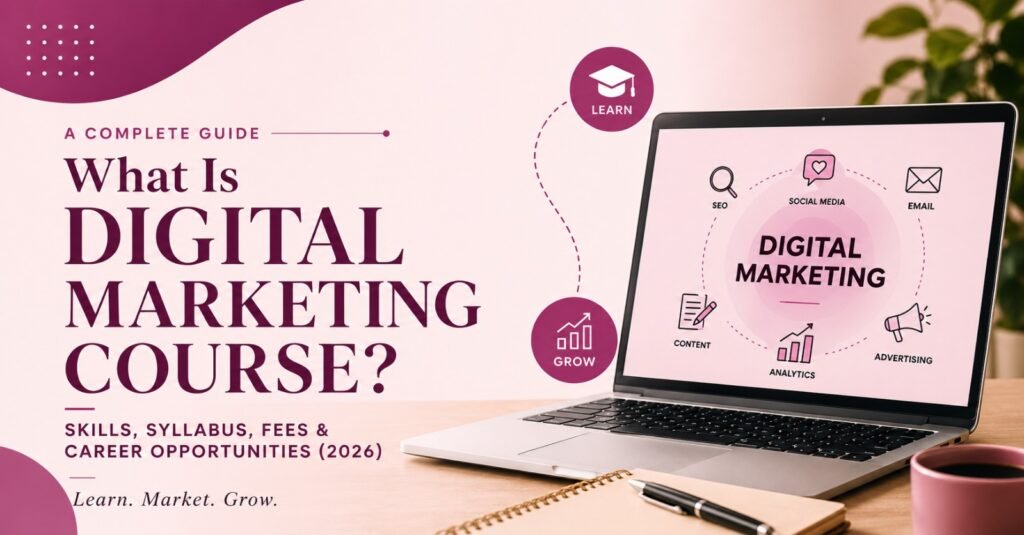
If you are searching for what is digital marketing course, you are probably planning to build a career in this field or want to improve your business’s online presence. A digital marketing course equips you with practical skills such as Search Engine Optimization (SEO), Google Ads, social media marketing, content marketing, email marketing, analytics, and AI-powered marketing strategies. These skills can help you secure a high-paying job, start freelancing, or grow your own business.
Unlike many traditional courses that focus mainly on theory, a well-designed digital marketing course emphasizes hands-on learning. You’ll work on live projects, real business case studies, and industry-standard tools, giving you practical experience that employers value.
Whether you have just completed your 12th grade, graduated from college, are looking to switch careers, or run a small business, learning digital marketing can open doors to countless opportunities in India and around the world.
In this comprehensive guide, you’ll learn:
- What is a digital marketing course?
- Why digital marketing is important in 2026
- Skills you will learn
- Complete course syllabus
- Eligibility and duration
- Course fees in India
- Career opportunities and salary
- Best certifications
- How to choose the right digital marketing institute
By the end of this article, you’ll have a clear understanding of whether a digital marketing course is the right choice for your career goals.
What Is Digital Marketing Course?
A digital marketing course is a structured training program that teaches you how to promote products, services, or brands using digital platforms such as search engines, social media, websites, email, mobile applications, and online advertising.
In simple words, if you’ve ever searched for something on Google, clicked on a Facebook ad, watched a sponsored YouTube video, or received a promotional email from a brand, you’ve experienced digital marketing in action.
A digital marketing course helps you understand the strategies, tools, and techniques behind these online marketing activities. It combines theoretical knowledge with practical training so you can confidently execute real-world marketing campaigns.
Digital Marketing Course Definition
A digital marketing course is a professional training program that teaches individuals how to market businesses online using channels like Google Search, social media, email, websites, paid advertising, and content marketing to generate traffic, leads, and sales.
The primary objective of the course is to help learners develop practical digital marketing skills that can be applied in jobs, freelancing, entrepreneurship, or business growth.
What Is Included in a Digital Marketing Course?
A modern digital marketing course covers multiple marketing channels instead of focusing on just one skill. Since businesses use different platforms to reach their audience, digital marketers need expertise in several areas.
Some of the key topics generally included are:
- Search Engine Optimization (SEO)
- Google Ads (Pay-Per-Click Advertising)
- Social Media Marketing (SMM)
- Content Marketing
- Email Marketing
- Affiliate Marketing
- Influencer Marketing
- Web Analytics
- Conversion Rate Optimization (CRO)
- Website Creation using WordPress
- AI Tools for Marketing
- Marketing Automation
- E-commerce Marketing
By learning these modules, students gain a complete understanding of how digital marketing campaigns are planned, executed, measured, and optimized.
Why Should You Learn Digital Marketing?
Today’s consumers spend a significant amount of time online. Whether they’re searching for restaurants, booking hotels, shopping for clothes, or watching videos, most buying decisions begin with an online search.
Businesses understand this shift in consumer behavior. As a result, they invest heavily in digital marketing to connect with potential customers.
Learning digital marketing enables you to become part of this rapidly expanding industry.
Here are some reasons why people choose to learn digital marketing:
- High demand across industries
- Attractive salary packages
- Work-from-home opportunities
- Freelancing flexibility
- Business growth opportunities
- Continuous learning with AI and automation
- Global career prospects
- No coding knowledge required
Who Should Join a Digital Marketing Course?
One of the biggest advantages of digital marketing is that it welcomes learners from almost every educational background.
You don’t need an engineering degree, MBA, or advanced technical knowledge to begin your journey.
A digital marketing course is suitable for:
Students
Students can build practical skills alongside their academic studies, making them more employable after graduation.
Fresh Graduates
Graduates often struggle with limited practical experience. Digital marketing courses provide hands-on exposure that helps improve job readiness.
Working Professionals
Professionals looking to switch careers or enhance their current roles can benefit from digital marketing expertise.
Business Owners
Entrepreneurs can reduce marketing costs and grow their businesses by learning how to attract customers online.
Freelancers
Freelancers can offer services like SEO, social media management, Google Ads, and content marketing to clients worldwide.
Homemakers
Many homemakers successfully build freelance careers or home-based businesses after learning digital marketing.
Career Switchers
People from industries such as banking, sales, customer support, education, or hospitality often transition into digital marketing due to its excellent growth potential.
What Makes a Good Digital Marketing Course?
Not all courses offer the same learning experience.
A quality digital marketing course should include:
- Industry-updated curriculum
- Practical assignments
- Live projects
- Case studies
- AI-powered marketing tools
- Internship opportunities
- Placement assistance
- Certifications
- Experienced trainers
- Portfolio development
Practical learning is especially important because employers prefer candidates who can demonstrate real skills rather than just theoretical knowledge.
What Is the Difference Between Traditional Marketing and Digital Marketing?
Understanding this difference helps explain why digital marketing has become such a valuable career option.
| Traditional Marketing | Digital Marketing |
|---|---|
| TV advertisements | Google Ads |
| Newspaper ads | SEO & Content Marketing |
| Radio promotions | Podcast Marketing |
| Billboards | Social Media Ads |
| Flyers & Brochures | Email Marketing |
| Difficult to measure | Easily measurable with analytics |
| Expensive campaigns | Cost-effective campaigns |
| Limited audience targeting | Highly targeted audience segmentation |
Digital marketing allows businesses to track almost every aspect of a campaign, including website visits, clicks, conversions, sales, and return on investment (ROI). This data-driven approach makes marketing more efficient and effective.
Why Digital Marketing Is Important in 2026
The digital landscape is evolving faster than ever. With increasing internet penetration, smartphone usage, AI-powered technologies, and online shopping, businesses can no longer rely solely on traditional marketing methods.
Digital marketing has become a core business function rather than just an optional promotional strategy.
Let’s explore why digital marketing is more important than ever in 2026.
1. Businesses Are Going Digital
From local grocery stores to global brands, almost every business has established an online presence.
Customers now expect businesses to have:
- A professional website
- Google Business Profile
- Active social media pages
- Online customer support
- Digital payment options
- Online reviews
As businesses compete online, they require skilled digital marketers who can help them attract, engage, and convert customers.
2. The Growth of E-commerce
Online shopping has transformed consumer behavior.
Customers prefer the convenience of ordering products from home, comparing prices online, reading reviews, and receiving doorstep delivery.
This growth has increased demand for professionals skilled in:
- SEO
- Paid advertising
- Social media campaigns
- Marketplace optimization
- Product content creation
- Performance marketing
E-commerce companies continuously hire digital marketing professionals to stay ahead of competitors.
3. Artificial Intelligence Is Transforming Marketing
Artificial Intelligence (AI) is reshaping how marketers work.
Instead of replacing digital marketers, AI helps them become more productive by automating repetitive tasks and providing valuable insights.
Modern digital marketers use AI for:
- Content generation
- Keyword research
- Ad copy creation
- Customer segmentation
- Marketing automation
- Chatbots
- Predictive analytics
- Campaign optimization
Learning digital marketing today also means learning how to effectively use AI-powered tools alongside traditional marketing strategies.
4. Digital Marketing Offers Diverse Career Opportunities
Unlike many professions with limited specialization, digital marketing offers multiple career paths.
Professionals can specialize in:
- Search Engine Optimization (SEO)
- Google Ads
- Social Media Marketing
- Content Marketing
- Email Marketing
- Affiliate Marketing
- Performance Marketing
- Analytics
- Marketing Automation
- E-commerce Marketing
- AI Marketing
This flexibility allows individuals to choose a specialization based on their interests and strengths.
5. High Demand Across Industries
Digital marketing isn’t limited to IT companies.
Professionals are needed across industries such as:
- Healthcare
- Education
- Finance
- Real Estate
- Travel
- Hospitality
- Fashion
- Retail
- Manufacturing
- Entertainment
- Food & Beverage
- SaaS
- Startups
This broad demand makes digital marketing a stable and future-ready career.
6. Opportunities Beyond Traditional Jobs
One of the biggest advantages of learning digital marketing is the flexibility it offers.
After gaining practical experience, you can:
- Work in a company
- Become a freelancer
- Start your own digital marketing agency
- Build a personal brand
- Launch an online business
- Create a blog
- Start a YouTube channel
- Sell digital products
- Offer consulting services
This versatility makes digital marketing one of the most rewarding career options available today.
Key Takeaways
If you’re wondering what is digital marketing course, the answer is simple: it is a practical, career-focused training program that teaches you how to promote businesses online using modern digital channels such as search engines, social media, websites, email, and paid advertising.
In 2026, digital marketing is more than just a trending skill—it’s an essential capability for businesses and professionals alike. Whether your goal is to secure a high-paying job, grow your business, or build a successful freelance career, a digital marketing course can provide the knowledge and hands-on experience needed to achieve it.
What Will You Learn in a Digital Marketing Course?
One of the most common questions students ask after understanding what is digital marketing course is, “What exactly will I learn during the course?”
The answer depends on the institute and the course level (beginner, advanced, or professional). However, a comprehensive digital marketing course covers all the essential skills required to plan, execute, analyze, and optimize online marketing campaigns.
Unlike traditional classroom learning, digital marketing is a practical skill. You’ll not only learn concepts but also use real tools, work on live projects, and solve real-world marketing problems.
By the end of a good digital marketing course, you’ll be able to:
- Build and optimize websites
- Rank websites on Google using SEO
- Run paid advertising campaigns
- Create engaging social media strategies
- Write SEO-friendly content
- Generate leads and sales online
- Analyze website traffic using analytics tools
- Automate marketing processes
- Use AI tools to improve productivity
- Measure campaign performance and ROI
Let’s explore each module in detail.
Search Engine Optimization (SEO)
Search Engine Optimization (SEO) is one of the most valuable skills you’ll learn in a digital marketing course. SEO helps websites rank higher on search engines like Google, making it easier for potential customers to find businesses organically.
For example, if someone searches “best digital marketing course in Mumbai,” SEO determines which websites appear on the first page of Google.
Since organic traffic is free and highly targeted, almost every business invests in SEO.
Topics Covered in SEO
Keyword Research
You’ll learn how to identify the words and phrases people search for online using tools like:
- Google Keyword Planner
- Google Trends
- Ubersuggest
- SEMrush
- Ahrefs
Understanding search intent and keyword difficulty is a crucial part of creating content that ranks.
On-Page SEO
This module teaches you how to optimize individual web pages by improving:
- Title tags
- Meta descriptions
- URL structure
- Heading tags (H1, H2, H3)
- Internal linking
- Image optimization
- Content quality
- Keyword placement
Off-Page SEO
You’ll understand how websites build authority through:
- Link building
- Guest blogging
- Business citations
- Social bookmarking
- Digital PR
- Brand mentions
Technical SEO
Technical SEO ensures search engines can crawl and index websites efficiently.
Topics include:
- Website speed optimization
- Mobile responsiveness
- XML Sitemap
- Robots.txt
- Canonical tags
- Schema markup
- Core Web Vitals
- Crawl errors
Google Ads (Pay-Per-Click Advertising)
SEO takes time to deliver results, but Google Ads allows businesses to appear at the top of search results almost instantly.
This module teaches you how to create and manage paid advertising campaigns that generate traffic, leads, and sales.
Topics Covered
Search Ads
Learn how to create text ads that appear on Google Search.
Display Ads
Design visual banner ads that appear across millions of websites.
Video Ads
Understand YouTube advertising strategies.
Shopping Ads
Ideal for e-commerce businesses selling physical products.
Performance Max Campaigns
Learn Google’s AI-powered advertising campaigns that optimize ads across multiple channels.
Skills You’ll Gain
- Campaign setup
- Keyword targeting
- Bid strategies
- Audience targeting
- Conversion tracking
- Budget management
- ROI optimization
- Ad copywriting
Social Media Marketing (SMM)
Social media has become one of the most powerful marketing channels for businesses of every size.
A digital marketing course teaches how brands use social media to build awareness, engage customers, generate leads, and increase sales.
Platforms Covered
- X (formerly Twitter)
- YouTube
Topics You’ll Learn
- Social media strategy
- Content planning
- Content calendars
- Organic growth
- Community management
- Social media advertising
- Audience engagement
- Analytics
You’ll also learn how different platforms serve different business goals. For example:
- LinkedIn works well for B2B marketing.
- Instagram is ideal for lifestyle brands.
- Facebook is useful for local businesses.
- YouTube is excellent for educational and video content.
Content Marketing
Content is often called the backbone of digital marketing because every marketing channel relies on high-quality content.
Whether you’re writing blog posts, creating videos, designing social media posts, or sending emails, content plays a crucial role.
Topics Covered
- Blogging
- SEO content writing
- Copywriting
- Landing page content
- Website content
- Content strategy
- Storytelling
- AI-assisted content creation
Students also learn how to write content that satisfies both search engines and human readers.
Email Marketing
Despite the popularity of social media, email marketing remains one of the highest ROI marketing channels.
This module teaches how businesses build long-term relationships with customers through personalized email communication.
Topics Covered
- Email list building
- Lead magnets
- Newsletter creation
- Promotional emails
- Drip campaigns
- Marketing automation
- Segmentation
- A/B testing
You’ll also learn industry tools like:
- Mailchimp
- Brevo
- ConvertKit
- ActiveCampaign
Affiliate Marketing
Affiliate marketing allows individuals to earn commissions by promoting products or services online.
Many bloggers, YouTubers, influencers, and niche website owners generate passive income through affiliate marketing.
Topics Covered
- Affiliate marketing basics
- Affiliate networks
- Product selection
- Affiliate disclosures
- Tracking links
- Conversion optimization
- Content strategies
Influencer Marketing
Consumers trust recommendations from creators they follow.
This has made influencer marketing one of the fastest-growing digital marketing channels.
Topics Covered
- Influencer selection
- Campaign planning
- Brand collaboration
- Budgeting
- Performance tracking
- ROI measurement
You’ll understand how brands collaborate with creators across Instagram, YouTube, and LinkedIn.
Website Development Using WordPress
Every digital marketer should understand the basics of websites.
Most digital marketing courses include WordPress training because it’s the world’s most popular Content Management System (CMS).
Topics Covered
- Domain & hosting
- Installing WordPress
- Themes
- Plugins
- Website customization
- Landing pages
- Blog creation
- Contact forms
- Basic SEO settings
The goal isn’t to become a web developer but to confidently manage business websites.
Google Analytics 4 (GA4)
Running marketing campaigns without analytics is like driving with your eyes closed.
Google Analytics helps businesses understand:
- Where visitors come from
- Which pages perform best
- User behavior
- Conversion rates
- Campaign effectiveness
Topics Covered
- GA4 setup
- Event tracking
- User acquisition
- Traffic reports
- Conversion reports
- Audience insights
- Custom dashboards
Analytics skills help marketers make informed decisions using real data.
Google Search Console
Google Search Console is a free tool that helps monitor website performance in Google Search.
Students learn how to:
- Submit XML sitemaps
- Monitor indexing
- Identify crawl errors
- Improve search visibility
- Track keyword rankings
- Analyze clicks and impressions
Conversion Rate Optimization (CRO)
Generating website traffic is only half the job.
Conversion Rate Optimization focuses on turning visitors into customers.
Topics Covered
- Landing page optimization
- User experience (UX)
- Call-to-action design
- Heatmaps
- A/B testing
- Funnel optimization
Learning CRO helps businesses increase sales without increasing advertising budgets.
Marketing Automation
Modern marketers automate repetitive tasks to improve efficiency.
Automation tools save time while delivering personalized customer experiences.
Topics Covered
- Lead nurturing
- Workflow automation
- CRM integration
- Automated emails
- Customer journeys
- Sales funnels
Popular tools include:
- HubSpot
- Zapier
- Make (formerly Integromat)
AI Tools for Digital Marketing
Artificial Intelligence has become an integral part of digital marketing in 2026.
Instead of replacing marketers, AI enhances productivity by automating tasks and generating insights.
A good digital marketing course now includes AI training as part of the curriculum.
AI Tools Commonly Covered
- ChatGPT
- Google Gemini
- Canva AI
- Claude
- Microsoft Copilot
- Midjourney
- Adobe Firefly
- Perplexity AI
Practical AI Applications
Students learn how to use AI for:
- Keyword research
- Blog writing
- Ad copy creation
- Email drafting
- Social media captions
- Content ideas
- Image generation
- Competitor analysis
- Marketing strategy
- SEO optimization
Learning AI ensures students stay competitive in the evolving digital marketing industry.
E-commerce Marketing
With the rapid growth of online shopping, businesses need marketers who understand e-commerce.
This module focuses on promoting products sold through online stores.
Topics Covered
- Shopify basics
- WooCommerce
- Product optimization
- Marketplace marketing
- Shopping campaigns
- Product SEO
- Cart abandonment strategies
- Customer retention
Digital Marketing Course Syllabus (Complete Modules)
While every institute has its own curriculum, a professional digital marketing course generally includes the following modules.
| Module | Topics Covered |
|---|---|
| Introduction to Digital Marketing | Digital ecosystem, marketing fundamentals |
| Website Planning | Domain, hosting, WordPress |
| Search Engine Optimization (SEO) | On-page, Off-page, Technical SEO |
| Local SEO | Google Business Profile, Maps optimization |
| Google Ads | Search, Display, Video, Shopping, Performance Max |
| Social Media Marketing | Facebook, Instagram, LinkedIn, X |
| Content Marketing | Blogging, Copywriting, Content Strategy |
| Email Marketing | Automation, Campaigns, Segmentation |
| Affiliate Marketing | Networks, Commission Models |
| Influencer Marketing | Creator Collaborations |
| Analytics | Google Analytics 4 |
| Search Console | Website Performance |
| AI Marketing | Prompt Engineering, AI Tools |
| Marketing Automation | CRM, Workflows |
| E-commerce Marketing | Shopify, WooCommerce |
| Freelancing | Client Acquisition |
| Resume Building | Portfolio Development |
| Interview Preparation | Mock Interviews |
| Live Projects | Real Client Campaigns |
| Internship | Practical Industry Experience |
Skills You Will Gain After Completing a Digital Marketing Course
A professional digital marketing course doesn’t just teach software or tools—it helps you develop practical, job-ready skills that employers value.
By completing the course, you’ll gain expertise in:
Technical Skills
- Search Engine Optimization (SEO)
- Google Ads Management
- Social Media Marketing
- Content Writing
- Copywriting
- Website Management
- WordPress
- Google Analytics
- Email Marketing
- Marketing Automation
- Keyword Research
- AI Prompt Engineering
- Performance Marketing
- Local SEO
- E-commerce Marketing
Analytical Skills
You’ll learn how to:
- Analyze website traffic
- Understand user behavior
- Measure campaign performance
- Improve conversion rates
- Track ROI
- Make data-driven decisions
Creative Skills
Digital marketers also develop creativity by learning how to:
- Write engaging content
- Design campaign ideas
- Create social media strategies
- Produce compelling advertisements
- Build brand storytelling
Business Skills
You’ll also gain valuable professional skills such as:
- Communication
- Client management
- Project management
- Time management
- Presentation skills
- Problem-solving
- Strategic thinking
These skills are transferable across industries and can help you grow in marketing, business, or entrepreneurship.
Key Takeaways
Now that you understand what is digital marketing course, it’s equally important to know what you’ll actually learn. A comprehensive course goes far beyond social media or SEO—it equips you with a complete toolkit for online marketing, from website creation and content strategy to paid advertising, analytics, AI tools, and marketing automation.
Whether your goal is to land a job, grow your business, or build a freelance career, mastering these modules will prepare you for real-world digital marketing challenges.
Who Should Join a Digital Marketing Course?
One of the biggest advantages of learning digital marketing is that it is open to everyone. Unlike many professional courses that require a specific educational background or technical expertise, a digital marketing course welcomes learners from diverse fields.
If you’re wondering what is digital marketing course and whether it’s the right choice for you, the answer depends on your career goals rather than your academic qualification.
Whether you’re a student planning your future, a working professional looking for better opportunities, or a business owner aiming to grow online, a digital marketing course can provide practical skills that are highly relevant in today’s digital economy.
Let’s explore who can benefit the most from learning digital marketing.
Students
If you’re pursuing your graduation or have recently completed your studies, learning digital marketing can give you a significant advantage in the job market.
Today, employers prefer candidates who possess practical skills in addition to academic qualifications. A digital marketing course helps students build industry-ready skills before they enter the workforce.
Benefits for Students
- Learn job-oriented skills while studying
- Build a professional portfolio
- Gain internship opportunities
- Improve placement chances
- Earn freelance income during college
- Develop personal branding
- Stay ahead of competitors
Many students also start blogs, YouTube channels, or Instagram pages while learning digital marketing, giving them valuable real-world experience.
Fresh Graduates
Many graduates face challenges when searching for their first job because employers often expect practical experience.
A digital marketing course bridges this gap by providing hands-on training, live projects, and exposure to industry-standard tools.
Why Freshers Should Learn Digital Marketing
- High demand across industries
- Multiple entry-level job roles
- Competitive starting salaries
- No prior experience required
- Opportunities for rapid career growth
Popular beginner roles include:
- Digital Marketing Executive
- SEO Executive
- Social Media Executive
- PPC Executive
- Content Writer
- Email Marketing Executive
Working Professionals
If you’re feeling stuck in your current role or looking for better career growth, digital marketing can open new opportunities.
Professionals from sales, customer service, banking, education, HR, hospitality, and many other industries are successfully transitioning into digital marketing.
Benefits for Working Professionals
- Career switch opportunities
- Salary growth
- Work-from-home flexibility
- Better job satisfaction
- AI-driven skill development
- Leadership opportunities
Since many courses offer weekend and online classes, working professionals can upskill without leaving their jobs.
Entrepreneurs and Business Owners
Every business today needs an online presence.
Whether you own a local shop, restaurant, coaching institute, clothing store, clinic, or startup, digital marketing helps you reach more customers and grow your business.
Learning digital marketing enables entrepreneurs to:
- Generate online leads
- Increase website traffic
- Build brand awareness
- Reduce advertising costs
- Improve customer engagement
- Measure marketing performance
Instead of relying entirely on external agencies, business owners who understand digital marketing can make informed marketing decisions and maximize their return on investment (ROI).
Freelancers
Digital marketing offers excellent opportunities for freelancers to work with clients across India and around the world.
Popular freelance services include:
- SEO
- Google Ads Management
- Social Media Management
- Content Writing
- Email Marketing
- Website Optimization
- WordPress Development
- Analytics Reporting
Freelancers enjoy flexible working hours, location independence, and the potential to build long-term client relationships.
Homemakers
Many homemakers choose digital marketing because it offers flexible learning and work opportunities.
After completing a digital marketing course, homemakers can:
- Work from home
- Manage social media for local businesses
- Start freelancing
- Build personal blogs
- Launch online businesses
- Sell handmade products online
The flexibility of digital marketing makes it an excellent career option for those balancing family responsibilities.
Career Switchers
One of the strongest advantages of digital marketing is that it values skills more than educational background.
People from various industries successfully transition into digital marketing, including:
- Banking
- Insurance
- Retail
- Manufacturing
- Hospitality
- Healthcare
- Teaching
- Customer Support
- Sales
- Administration
With practical training and certifications, career switchers can build a rewarding career in digital marketing.
Eligibility for a Digital Marketing Course
Another common question people ask while searching what is digital marketing course is:
“Who is eligible to join a digital marketing course?”
The good news is that digital marketing has very few eligibility requirements compared to many other professional courses.
Let’s look at the common criteria.
Educational Qualification
Most digital marketing institutes accept students who have completed:
- 10th Standard (basic courses)
- 12th Standard
- Diploma
- Graduation
- Post Graduation
Many advanced certification programs recommend graduation, but it’s not always mandatory.
Age Criteria
There is usually no upper age limit.
People from different age groups successfully learn digital marketing.
Typical learners include:
- School students
- College students
- Fresh graduates
- Professionals
- Entrepreneurs
- Retired individuals
Learning depends more on interest than age.
Computer Knowledge
Basic computer knowledge is sufficient.
Students should know:
- Internet browsing
- MS Office basics
- Email usage
- Basic typing
Advanced technical skills are not required.
English Language Skills
Since many digital marketing tools and resources are available in English, having a basic understanding of the language is helpful.
However, many institutes teach in regional languages or bilingual formats, making digital marketing accessible to a wider audience.
Do You Need Coding Skills?
No.
This is one of the biggest misconceptions.
A digital marketing course does not require programming knowledge.
Although basic HTML can be useful for SEO and website management, most marketing tasks do not involve coding.
Modern tools like WordPress, drag-and-drop website builders, AI assistants, and marketing platforms make digital marketing accessible even for non-technical learners.
Is a Marketing Background Required?
No.
Students from any educational background can learn digital marketing, including:
- Commerce
- Science
- Arts
- Engineering
- Pharmacy
- Hotel Management
- Law
- Medicine
- Architecture
The curriculum starts with fundamentals before moving to advanced topics.
Duration of a Digital Marketing Course
The duration of a digital marketing course depends on:
- Course level
- Institute
- Learning format
- Curriculum
- Practical training
- Internship
Some learners want to gain basic skills quickly, while others prefer comprehensive programs with live projects and placement support.
The table below provides an overview.
| Course Type | Typical Duration | Suitable For |
|---|---|---|
| Free Online Courses | Self-paced | Beginners |
| Crash Course | 1 Month | Professionals looking for quick upskilling |
| Beginner Certification | 2–3 Months | Students and Freshers |
| Advanced Certification | 4–6 Months | Career-oriented learners |
| Professional Diploma | 6–12 Months | Complete beginners seeking in-depth training |
Which Course Duration Is Best?
The ideal duration depends on your career goals.
If You Want Basic Knowledge
A short certification course lasting one to two months may be sufficient.
If You Want a Job
Choose a 4–6 month practical training program that includes:
- Live projects
- Certifications
- Internship
- Placement assistance
If You Want to Become a Specialist
Select an advanced diploma covering:
- SEO
- Google Ads
- Analytics
- AI Marketing
- Automation
- Performance Marketing
- Portfolio Building
Remember, learning doesn’t stop after completing the course. Digital marketing evolves continuously, so staying updated with new trends and tools is essential.
Digital Marketing Course Fees in India (2026)
The cost of a digital marketing course varies depending on several factors, such as:
- Institute reputation
- Course duration
- Trainer expertise
- Curriculum depth
- Live projects
- Internship opportunities
- Placement assistance
- Certifications included
- Learning mode (online/offline)
There is no single fee structure applicable to every institute.
Below is an approximate fee range in India.
| Course Type | Average Fees (India) |
|---|---|
| Free Courses | ₹0 |
| Basic Certification | ₹5,000 – ₹15,000 |
| Intermediate Course | ₹15,000 – ₹30,000 |
| Professional Certification | ₹30,000 – ₹60,000 |
| Advanced Diploma | ₹60,000 – ₹1,20,000+ |
What Affects the Course Fees?
1. Course Curriculum
Courses covering AI marketing, automation, analytics, and performance marketing usually cost more because they offer advanced industry skills.
2. Trainer Experience
Experienced trainers with real industry expertise generally charge higher fees.
3. Live Projects
Institutes providing practical assignments and real client projects often have premium pricing.
4. Internship Programs
Courses that include internships help students gain industry experience, making them more valuable.
5. Placement Assistance
Placement support, resume building, mock interviews, and career guidance often increase the overall course fee.
6. Certifications
Courses offering multiple industry-recognized certifications may cost more but provide additional value.
Types of Digital Marketing Courses
Digital marketing education comes in various formats to suit different learning preferences.
Let’s explore the major options.
Online Digital Marketing Courses
Online courses have become increasingly popular because they offer flexibility and convenience.
Advantages
- Learn from anywhere
- Flexible schedules
- Affordable
- Recorded sessions
- Suitable for working professionals
Best For
- Students
- Working professionals
- Freelancers
- Homemakers
Offline Classroom Courses
Traditional classroom learning provides face-to-face interaction with trainers and peers.
Advantages
- Classroom environment
- Immediate doubt resolution
- Group activities
- Networking opportunities
Best For
- Freshers
- Students
- Learners who prefer in-person guidance
Hybrid Courses
Hybrid learning combines online and offline classes.
Students enjoy flexibility while also benefiting from classroom sessions for practical training and mentorship.
Self-Paced Courses
These courses allow learners to study at their own speed using recorded videos and learning materials.
Best For
- Busy professionals
- Entrepreneurs
- Independent learners
Instructor-Led Courses
Students attend live sessions conducted by experienced trainers.
Advantages include:
- Interactive learning
- Live demonstrations
- Personalized feedback
- Better accountability
Certification Programs
Short-term certification courses focus on practical skills and industry-recognized credentials.
Ideal for:
- Beginners
- Freshers
- Career switchers
Diploma Programs
Diploma courses offer in-depth training across all digital marketing modules.
They typically include:
- Live projects
- Internship
- Portfolio development
- Placement support
Degree Programs
Some universities now offer undergraduate and postgraduate degrees specializing in digital marketing.
These programs combine academic theory with practical marketing concepts but usually require a longer time commitment.
How to Choose the Right Course Format
Before enrolling, consider the following factors:
- Your career goals
- Available time
- Budget
- Learning style
- Practical training opportunities
- Placement support
- Certifications offered
- Access to mentors
- Industry relevance of the curriculum
Choosing the right course format can significantly impact your learning experience and career outcomes.
Key Takeaways
Understanding what is digital marketing course also means knowing whether it’s the right fit for your background, goals, and budget. The good news is that digital marketing is one of the most accessible career paths, with minimal eligibility requirements and flexible learning options for students, professionals, entrepreneurs, freelancers, and career switchers.
Whether you choose a short certification or an advanced diploma, focus on a course that offers practical training, live projects, industry-recognized certifications, and placement support. These factors will help you build real-world skills and improve your chances of career success.
Digital Marketing Certifications You Can Earn
If you’ve understood what is digital marketing course, the next important question is:
“Which certifications should I earn after completing the course?”
A certificate validates your knowledge and demonstrates to employers and clients that you have invested time in learning industry-relevant skills. However, it’s important to remember that skills and practical experience matter more than certificates alone.
The best digital marketing courses combine practical training with preparation for globally recognized certifications. These certifications can strengthen your resume, improve your LinkedIn profile, and increase your chances of getting shortlisted for interviews.
Let’s look at some of the most valuable digital marketing certifications in 2026.
1. Google Digital Marketing Certifications
Google offers several free certifications that are highly respected across the industry.
Popular certifications include:
- Google Ads Search Certification
- Google Ads Display Certification
- Google Ads Video Certification
- Google Analytics Certification
- AI-Powered Performance Ads Certification
Why Should You Earn Google Certifications?
- Globally recognized
- Free to obtain
- Improves resume credibility
- Demonstrates knowledge of Google’s advertising ecosystem
- Preferred by many employers
2. HubSpot Certifications
HubSpot is one of the world’s leading CRM and inbound marketing platforms.
Its free certification programs cover topics such as:
- Content Marketing
- Email Marketing
- Inbound Marketing
- Social Media Marketing
- SEO
- Sales Enablement
Benefits
- Industry-recognized
- Beginner-friendly
- Practical learning
- Excellent for content marketers
3. Meta Blueprint Certifications
Businesses spend billions on advertising across Facebook and Instagram every year.
Meta certifications help learners master:
- Facebook Ads
- Instagram Advertising
- Campaign Management
- Audience Targeting
- Meta Business Suite
These certifications are especially valuable for social media marketers and performance marketers.
4. Semrush Certifications
SEO professionals widely use Semrush for keyword research, competitor analysis, backlink analysis, and content optimization.
Popular certification topics include:
- SEO Fundamentals
- Keyword Research
- Technical SEO
- Local SEO
- Content Marketing
5. LinkedIn Learning Certifications
LinkedIn Learning offers courses covering:
- Digital Marketing Fundamentals
- Personal Branding
- Social Media Marketing
- Marketing Analytics
- Leadership Skills
These certifications also appear directly on your LinkedIn profile, increasing your professional visibility.
6. Microsoft Advertising Certifications
Businesses advertising on Microsoft’s search network also require trained professionals.
Microsoft certifications focus on:
- Search Advertising
- Audience Targeting
- Campaign Optimization
- Performance Analysis
7. AI Marketing Certifications
Artificial Intelligence has become an essential part of digital marketing.
Several organizations now offer certifications covering:
- AI Prompt Engineering
- Marketing Automation
- AI Content Creation
- AI Productivity
- AI for Advertising
Learning AI tools alongside traditional marketing skills gives professionals a significant competitive advantage.
Why Are Certifications Important?
While employers prioritize practical skills, certifications provide additional credibility.
They help you:
- Improve your resume
- Build professional credibility
- Showcase continuous learning
- Prepare for interviews
- Increase confidence
- Stand out from other candidates
However, remember one important principle:
A portfolio of successful projects is always more valuable than a long list of certificates.
The ideal combination is:
Practical Skills + Live Projects + Industry Certifications
Career Opportunities After Completing a Digital Marketing Course
One of the biggest reasons people search what is digital marketing course is because they want to understand the career opportunities available after completing the course.
The good news is that digital marketing offers one of the widest ranges of career options in today’s job market.
Every organization that wants customers online requires digital marketing professionals.
Whether it’s a startup, multinational company, e-commerce brand, hospital, educational institute, travel agency, or local business, digital marketing plays a crucial role.
Popular Digital Marketing Job Roles
Let’s explore some of the most common career options.
Digital Marketing Executive
This is the most common entry-level role.
Responsibilities include:
- Managing digital campaigns
- Website updates
- Social media posting
- SEO support
- Analytics reporting
- Content publishing
Skills Required
- Basic SEO
- Google Ads
- Social Media
- Analytics
Average Salary (India)
₹3–6 LPA
SEO Executive
SEO specialists improve website rankings on search engines.
Daily responsibilities include:
- Keyword research
- On-page optimization
- Technical SEO
- Link building
- Website audits
- Performance tracking
Average Salary
₹3–5 LPA
Experienced SEO specialists often earn significantly higher salaries.
PPC Specialist (Google Ads Expert)
PPC professionals manage paid advertising campaigns.
Responsibilities include:
- Campaign creation
- Budget optimization
- Conversion tracking
- Ad copy testing
- ROI improvement
Average Salary
₹4–8 LPA
Performance marketing specialists with experience are among the highest-paid professionals in digital marketing.
Social Media Manager
Businesses actively hire professionals who can build and manage their online communities.
Responsibilities include:
- Content planning
- Community management
- Social media campaigns
- Influencer collaborations
- Performance reporting
Average Salary
₹4–8 LPA
Content Marketing Specialist
Content marketers create valuable content that attracts customers organically.
Responsibilities include:
- Blog writing
- Content strategy
- SEO writing
- Website content
- Landing pages
- Email copy
Average Salary
₹4–7 LPA
Email Marketing Specialist
Email marketers focus on customer communication and automation.
Responsibilities include:
- Newsletter creation
- Automation workflows
- Segmentation
- Campaign optimization
Average Salary
₹4–8 LPA
Performance Marketing Specialist
Performance marketers focus entirely on measurable business outcomes.
Responsibilities include:
- Google Ads
- Meta Ads
- Conversion optimization
- Campaign scaling
- Budget allocation
- ROI reporting
Average Salary
₹6–12 LPA
Digital Marketing Manager
After gaining several years of experience, professionals often move into management roles.
Responsibilities include:
- Marketing strategy
- Team management
- Budget planning
- Campaign execution
- Business growth
Average Salary
₹8–18 LPA
Senior managers and heads of digital marketing can earn substantially more depending on the company and experience.
Digital Marketing Salary in India (2026)
The table below provides approximate salary ranges.
| Job Role | Average Salary |
|---|---|
| SEO Executive | ₹3–5 LPA |
| Digital Marketing Executive | ₹3–6 LPA |
| Social Media Executive | ₹3–6 LPA |
| Content Writer | ₹3–6 LPA |
| Google Ads Specialist | ₹4–8 LPA |
| Email Marketing Specialist | ₹4–8 LPA |
| Performance Marketer | ₹6–12 LPA |
| Digital Marketing Manager | ₹8–18 LPA |
| Head of Digital Marketing | ₹15–35+ LPA |
Note: Salaries vary depending on location, company size, industry, experience, certifications, and practical skills.
Industries Hiring Digital Marketers
One major advantage of digital marketing is that almost every industry requires marketing professionals.
Some major hiring sectors include:
- IT Companies
- Startups
- E-commerce
- Healthcare
- Education
- Banking
- Finance
- Real Estate
- Hospitality
- Tourism
- Manufacturing
- Retail
- Fashion
- Automobile
- SaaS Companies
- Media & Entertainment
This diversity makes digital marketing one of the most recession-resistant career options.
Can You Get a Job After Completing a Digital Marketing Course?
Yes—but getting a job depends on more than just completing a course.
Employers typically look for candidates who have:
- Practical knowledge
- Live project experience
- Portfolio
- Industry certifications
- Communication skills
- Problem-solving ability
- Basic analytical thinking
To improve your chances of getting hired:
- Build your own website
- Optimize it using SEO
- Run Google Ads campaigns (even with a small budget)
- Create a LinkedIn profile
- Publish blog articles
- Build a portfolio of projects
- Complete internships
The more practical experience you gain, the stronger your job prospects become.
Freelancing Opportunities After Learning Digital Marketing
Not everyone wants a traditional full-time job.
Many professionals choose freelancing because it offers flexibility, independence, and unlimited earning potential.
Digital marketing is one of the most freelancer-friendly industries.
Popular Freelance Services
You can offer services such as:
- Search Engine Optimization (SEO)
- Google Ads Management
- Social Media Marketing
- Website SEO Audit
- Content Writing
- Email Marketing
- WordPress Website Setup
- Local SEO
- Marketing Consultation
- Analytics Reporting
Benefits of Freelancing
Freelancing allows you to:
- Work from home
- Choose your own clients
- Set your own schedule
- Earn in multiple currencies
- Build long-term business relationships
- Scale into your own agency
Many experienced freelancers eventually establish successful digital marketing agencies.
How to Start Freelancing
If you’re a beginner, follow these steps:
Step 1
Develop practical skills through projects.
Step 2
Create a professional portfolio.
Step 3
Build a LinkedIn profile.
Step 4
Create profiles on freelance platforms.
Step 5
Network with local businesses.
Step 6
Ask satisfied clients for testimonials.
Consistency and continuous learning are the keys to long-term freelance success.
Benefits of Learning Digital Marketing
By now, you have a clear understanding of what is digital marketing course and the opportunities it can create. Let’s summarize the key benefits of learning this valuable skill.
1. High Demand Career
Businesses of all sizes require digital marketers, ensuring a steady demand for skilled professionals.
2. Excellent Salary Potential
With experience and specialization, digital marketers can command competitive salaries and consulting fees.
3. Work from Anywhere
Many digital marketing roles support remote or hybrid work, allowing professionals to work from virtually anywhere with an internet connection.
4. Freelancing Opportunities
You can work independently with clients across industries and geographies, creating multiple income streams.
5. Start Your Own Business
Digital marketing knowledge empowers you to launch and grow your own online business or agency.
6. Build a Personal Brand
By consistently creating valuable content, you can establish yourself as an authority in your niche and attract career or business opportunities.
7. Continuous Learning
The field evolves with new platforms, AI tools, and consumer behaviors, making it ideal for lifelong learners who enjoy staying updated.
8. Applicable Across Industries
The skills you gain are transferable and valuable in almost every sector, from healthcare and education to retail and technology.
9. Cost-Effective Skill Development
Compared to many professional degrees, digital marketing courses are generally affordable and offer a faster path to employable skills.
10. Opportunity to Make an Impact
Digital marketers help businesses grow, connect with customers, and solve real business challenges, making the work both creative and measurable.
Key Takeaways
Completing a digital marketing course opens the door to a wide range of career paths, from SEO and social media management to performance marketing, content strategy, and digital marketing leadership. Whether you aim for a full-time job, freelance career, or entrepreneurial journey, the skills you acquire can create long-term professional opportunities.
To maximize your success, focus on building practical experience through live projects, earning relevant certifications, and maintaining a portfolio that demonstrates your capabilities. In the rapidly evolving world of digital marketing, continuous learning and adaptability are your greatest assets.
How to Choose the Best Digital Marketing Course
After understanding what is digital marketing course, learning about the syllabus, fees, certifications, and career opportunities, the next step is selecting the right course.
With hundreds of institutes offering digital marketing training, choosing the best one can feel overwhelming. Some courses focus only on theory, while others emphasize practical skills, live projects, and placement support.
Remember, the best digital marketing course isn’t necessarily the most expensive one—it’s the one that helps you build practical, job-ready skills.
Before investing your time and money, consider the following factors.